Wrap Engine
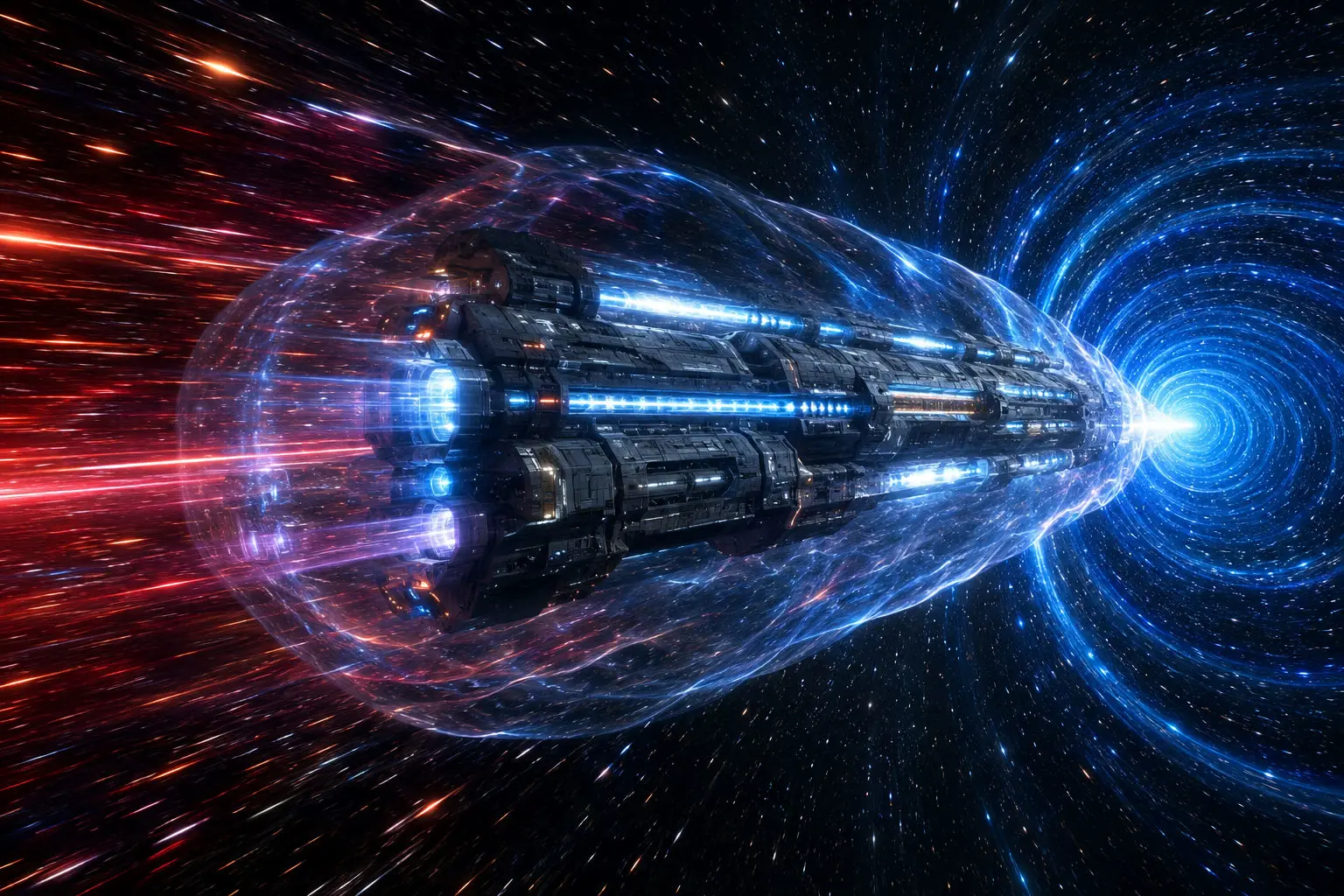
The wrap engine is the foundational faster-than-light travel system of the Space Adventures universe. In simple terms, it does not make a ship race through space faster than light in the usual way. Instead, it changes the shape of space around the ship so the ship can cross enormous distances while remaining locally slow and survivable.
For everyday people, the easiest picture is this: a normal engine pushes a ship through space, but a wrap engine moves space around the ship.
Summary
- Purpose: practical travel across star systems, sectors, and galactic distances
- Core idea: compress distance in front of the vessel and stretch distance behind it
- Main advantage: avoid the crippling travel times and severe time dilation of near-light travel
- Main weakness: extreme energy demand and very difficult field control
- Canon role: the common long-range travel method that made a settled galaxy possible
Canon Status
- Status: core mature technology during the main era of the tales
- Availability: common across developed worlds, frontier hubs, military fleets, and industrial relay stations
- Limitation: it can launch from many places, but not literally anywhere; safe wrap entry still requires enough clear space, navigation certainty, and power handling infrastructure
Why Ordinary Near-Light Travel Is Not Enough
Even if a civilization can build ships that travel at a large fraction of the speed of light, normal relativistic travel still creates major problems.
Distance remains brutal
The galaxy is too large for conventional travel to support a coherent civilization. Even light itself needs years to cross the gap between nearby stars and tens of thousands of years to cross the Milky Way. A ship that merely approaches light speed is still trapped by those scales.
Time dilation is not a real civilizational solution
At near-light speed, crew members experience less time than people who stay behind. This is real physics, not fiction. A crew may feel that a voyage lasted months, while years or centuries pass elsewhere.
That sounds useful until society is considered. Trade, politics, family, law, military coordination, and culture all break down if every long journey turns travelers into people from another era.
Relativistic ships can be good for one-way expeditions, sleeper missions, or desperate escapes. They are poor tools for a connected interstellar civilization.
How The Wrap Engine Works
The wrap engine is inspired by real theoretical ideas related to the Alcubierre metric and later warp-field research. In those models, a ship does not locally outrun light. Instead, spacetime is engineered into a moving bubble or field geometry.
Inside that bubble, the ship remains in a relatively calm local frame. Outside the bubble, the geometry of distance changes.
The usual simplified description is:
- space ahead of the ship is contracted
- space behind the ship is expanded
- the ship rides inside the moving distortion
Another useful way to say it is that the engine does not increase the ship's local velocity beyond light speed. It changes the path length that must be crossed.
Does It Solve The Time Problem?
Mostly, yes. That is one of the main reasons the wrap engine matters.
Because the vessel is not spending the whole trip accelerating to extreme relativistic velocity through ordinary space, the crew does not suffer the same kind of dramatic special-relativity time compression that would happen on a conventional near-light voyage.
In practical terms:
- travelers age close to normally during the trip
- home and destination clocks remain broadly compatible for routine travel
- a trip can feel like days or weeks for the crew without turning into decades for everyone else
That does not mean time effects disappear completely.
- entering and leaving the field still involves relativistic and gravitational corrections
- routes through intense gravity wells can create additional clock offsets
- extremely aggressive wrap profiles may produce measurable synchronization drift
So the answer for a beginner is simple: yes, the wrap engine avoids the worst time-dilation problem of near-light ships, which is why it is useful for civilization-scale travel.
Why It Is So Hard In Real Physics
Real-world warp-drive theory is still highly speculative. The biggest obstacle is energy.
Classical warp-drive proposals require exotic stress-energy conditions that ordinary matter does not provide easily. In plain language, the equations often demand forms of energy density, field structure, or vacuum manipulation that current human technology cannot generate or stabilize.
Major open problems in real science include:
- enormous total energy requirements
- the likely need for exotic or effectively negative energy configurations
- severe stability and steering problems at the edge of the bubble
- dangerous radiation or particle buildup near the front of the field
- unresolved causality issues if true faster-than-light motion is achieved
Because of these issues, the wrap engine remains hypothetical in real science.
Why It Becomes Possible In The Tales
The tales assume later breakthroughs that do not exist today.
Most importantly, high-density annihilation power systems and related field technologies provide the energy budget needed to form and sustain a wrap envelope. Other support technologies, described elsewhere in the encyclopedia, handle containment, metric shaping, bubble stabilization, inertial trimming, and navigation prediction.
That means the setting does not treat the wrap engine as magic. It treats it as the result of several other hard-won technologies maturing together.
Operational Model In The Space Adventures Universe
In common use, a wrap-capable ship follows six broad steps:
- Build a precise navigational solution for the destination corridor.
- Charge field banks and prime the metric envelope.
- Enter a safe wrap threshold outside dense traffic and deep atmosphere.
- Sustain the traveling bubble while the vessel remains locally stable inside it.
- Bleed excess field energy before exit.
- Re-enter normal space at a controlled distance from the destination.
This is why wrap travel is widespread but still professionalized. Anyone can board a wrap ship in major civilization zones, but not everyone can operate one safely.
Limits And Risks
The wrap engine is powerful, not effortless.
It is not ideal inside atmosphere
Most worlds prohibit wrap ignition inside populated atmospheres. Even if the field can form, the thermal, gravitational, and traffic risks are unacceptable.
Precision matters
Bad astrometrics, dust concentrations, gravity gradients, or unstable field harmonics can force emergency drop-out.
Energy cost is still strategic
Although the civilization of the tales can produce the required energy, the cost is still large enough to shape economics, military logistics, and politics.
It does not replace all other travel methods
Wrap travel is flexible because it can be used from many ordinary systems without fixed gates. But it is still slower, less precise, and more energy-hungry than gate-class transit where gates exist.
Wrap Engine Versus Hole Teleportation
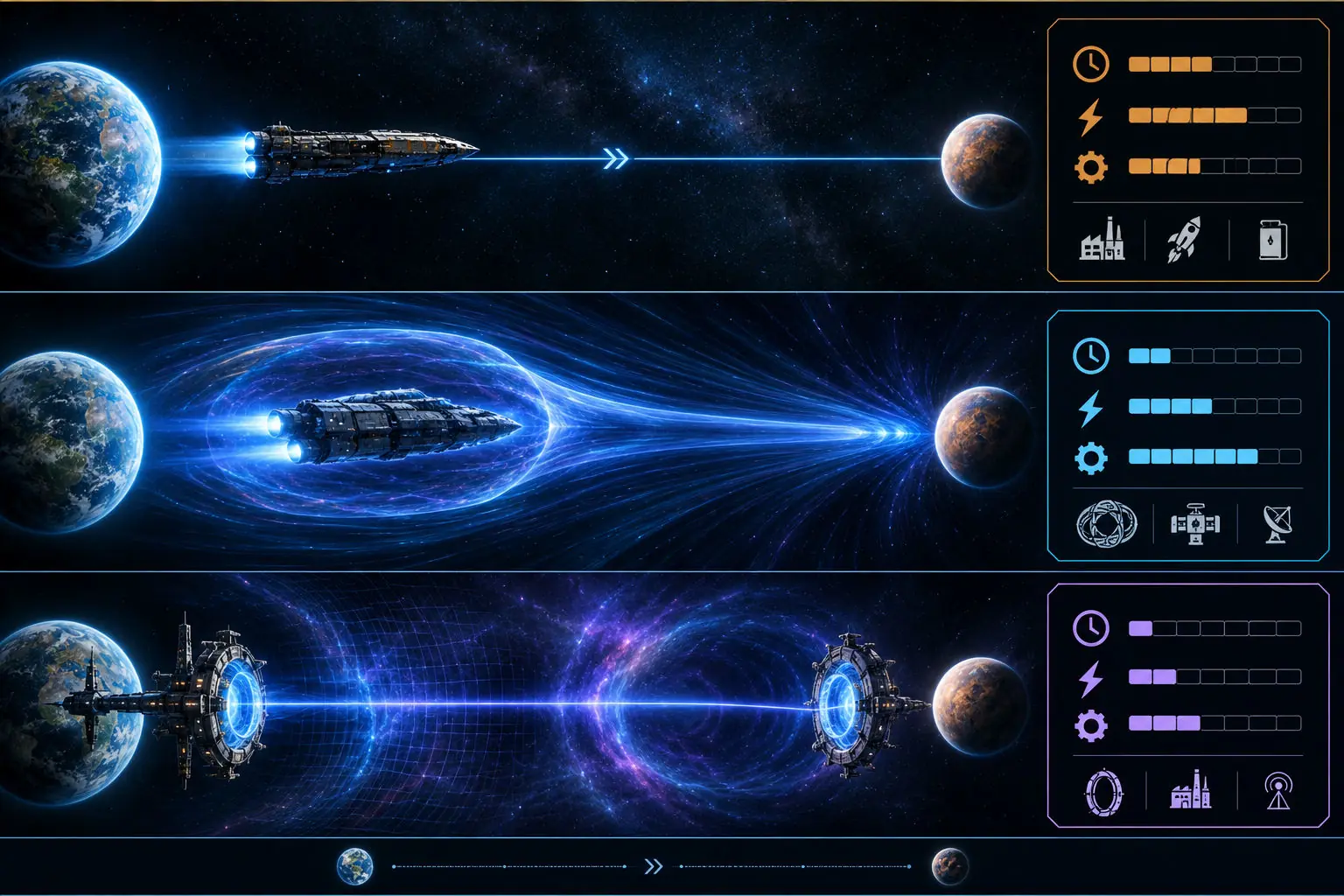
The two technologies complement each other.
| Technology | Best use | Main advantage | Main limitation |
|---|---|---|---|
| Wrap engine | Travel between most developed or frontier locations | Works without permanent gate infrastructure at every endpoint | High energy demand, route risk, lower precision than fixed gates |
| Hole teleportation | Instant or near-instant transfer between prepared nodes | Fastest possible strategic mobility | Requires specially built gates in rare, highly engineered locations |
Together, they form a believable interstellar transport network:
- wrap engines provide flexible movement across the galaxy
- hole teleportation connects the most important fixed hubs
- the combination makes expansion across the wider universe plausible
What Scientists Would Recognize In The Idea
Readers with a physics background would recognize several real concepts behind the fiction:
- relativity makes ordinary faster-than-light acceleration impossible for massive objects
- time dilation becomes severe near light speed
- general relativity allows spacetime itself to be curved and shaped
- warp-drive papers explore whether a moving spacetime geometry could bypass some limits of direct motion
- the hardest unsolved issue is not the math alone, but the matter and energy needed to make such a geometry physically real
The article therefore treats the wrap engine as science-inspired speculative engineering, not fantasy teleportation.
In-Universe Everyday Explanation
If explained to a passenger rather than a physicist:
A wrap ship does not win by making the ship itself impossibly fast. It wins by making the trip itself shorter. The crew stays inside a controlled pocket of near-normal space while the engine bends the surrounding geometry so the destination becomes reachable on human timescales.
Related Entries
- Travel Systems Overview
- Technologies Overview
- Hole teleportation: forthcoming article
Production Notes
- Real-science inspiration: Alcubierre warp-drive geometry, later positive-energy and subluminal warp-field research, and the known effects of relativistic time dilation.
- Fictional extension: mature annihilation power, stable field shaping, and practical control systems that do not exist today.
- Narrative role: makes a large, living, interconnected civilization possible without making distance meaningless.