System Drives And Local Propulsion
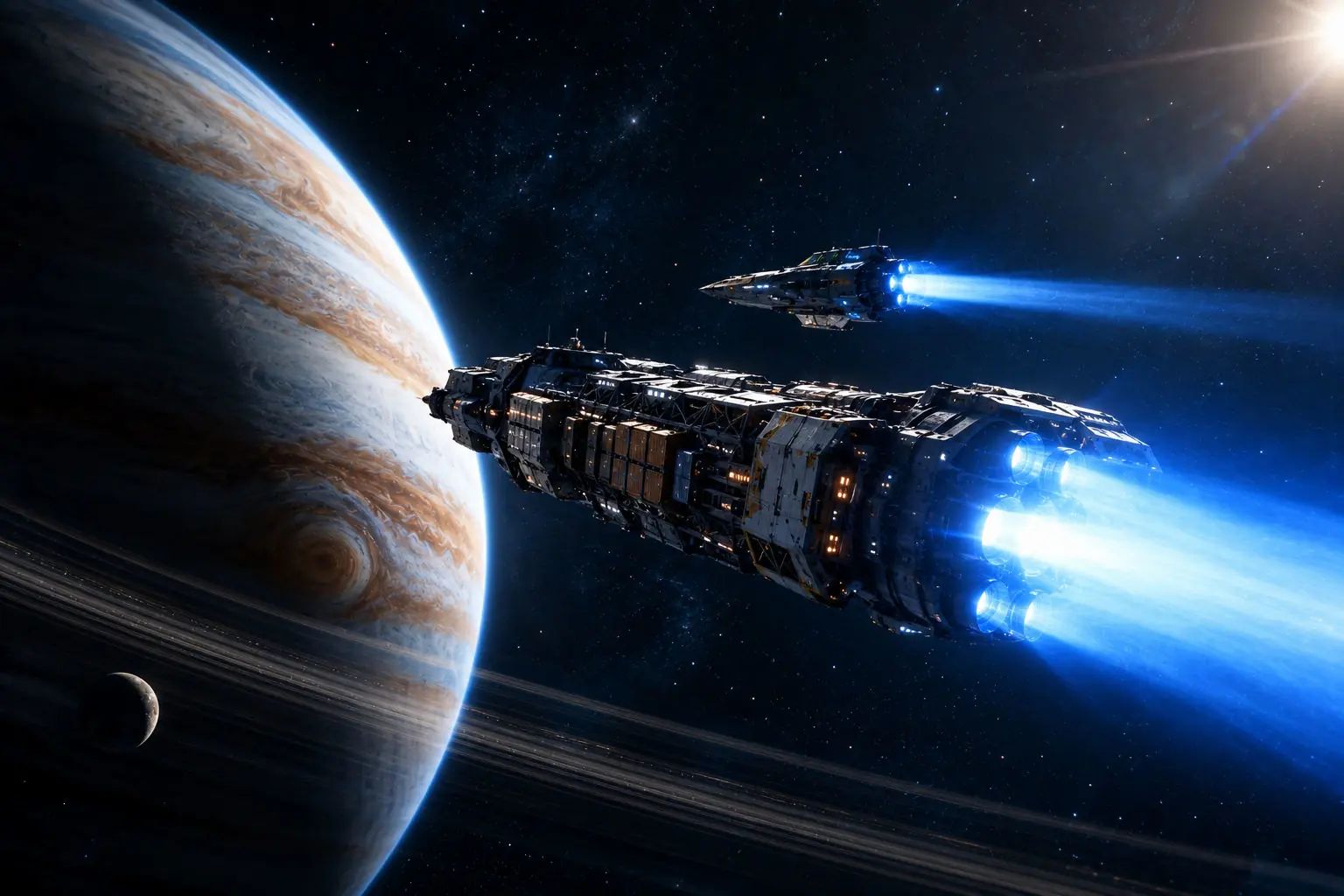
Every ship in the Space Adventures universe carries system drives. They are not the headline technology. Wrap engines and hole teleportation take that role. But system drives are the propulsion layer that is actually running almost all the time: during orbital maneuvers, station approaches, gravity-well transits, convoy formations, and the stretch of open space between where a ship drops out of wrap and where it is actually going.
The Key Distinction From FTL Technology
Wrap engines do not increase speed. They change the geometry of the route. Hole teleportation does not travel at all in the ordinary sense. It connects two points through an engineered spacetime passage.
System drives do neither. They apply force and build genuine velocity through ordinary space. This sounds simple until the question of time distortion arises.
Why Time Collapse Is Not A Problem At System Drive Speeds
Time dilation from velocity is real physics. A ship moving at a large fraction of the speed of light experiences measurably less time than people who stayed behind. At high enough fractions, the gap becomes civilizationally destructive.
That is exactly the problem that makes near-light-speed ships a poor foundation for a connected civilization — and exactly why the setting centers on geometry-based FTL rather than speed-based FTL.
System drives solve this by operating at velocities so far below light speed that relativistic time effects become negligibly small. At the speeds practical system drives sustain — typically ranging from a small fraction of a percent of light speed for heavy haulers to a few percent for military vessels — the time difference per voyage measures in seconds or at most minutes over journeys lasting days. No crew ages ahead of home. No civilization drifts apart.
The price is distance: these drives cannot cover interstellar distances on any human timescale. They are not meant to. That is the wrap engine's job.
Two Drive Categories
Vacuum kinematic drives
These are the primary propulsion system in open space, away from significant gravity wells.
Common drive families include:
- Fusion torch drives — high-thrust systems fed by micro-fusion reactions, producing directed exhaust with high specific impulse; the standard drive family for most military and commercial vessels
- Field-augmented drives — systems that combine direct exhaust with field-shaping technology to reduce the effective drag of spacetime curvature at high local acceleration, improving efficiency and peak velocity
- Plasma acceleration drives — high-efficiency systems that sacrifice raw thrust for fuel economy and long sustained burn; common on cargo haulers and exploratory vessels that need duration over sprint speed
Most ships carry a combination: a high-thrust system for critical maneuvers and departure burns, and a sustained-efficiency system for long coasting phases.
Gravity-environment drives
In atmosphere or deep inside a gravity well, different problems arise. Thrust alone is wasteful and structurally stressful at scale.
This is where antigravity mirror technology becomes propulsion.
An antigravity mirror does not push a ship through space by exhaust reaction. It counteracts gravitational load so effectively that the energy required to maintain altitude drops sharply, and small additional forces become sufficient to generate horizontal movement and controlled ascent or descent.
The result is that large ships can operate in atmosphere and at low orbit using a combination of antigravity lift and relatively modest directional thrust — the same visual principle that makes flying cargo freighters the size of ocean vessels practical without brute-force rocket thrust.
Above the usable antigravity field altitude, ships transition to vacuum kinematic drives.
Why Every Ship Needs Both Layers
A wrap-capable ship still needs system drives because:
- wrap ignition requires a safe minimum distance from gravity wells and populated space
- the ship must get to that ignition point somehow
- after dropping out of wrap, the ship must maneuver to its actual destination
- stations, docking, combat, convoy formation, and emergency repositioning all happen at system drive speeds
A ship that could only wrap and had no system drive capability would be essentially helpless once it arrived anywhere.
Travel Times At System Drive Speeds
These align with the operational ranges in Travel Times, Safety, And Strategy:
- Orbital repositioning: minutes to hours
- Planet-to-station or moon-to-moon transit: hours
- Inner system transit between planets: hours to days
- Outer system movement to or from a distant object: days to a few weeks
These times assume practical drive operation, not theoretical maximum thrust. Real voyages include acceleration, coasting, and deceleration phases, plus traffic, inspection, and approach control time.
Canon Default
Every vessel in the setting has system drives. They are background infrastructure, not story-worthy technology in themselves — unless a failure, chase, or combat maneuver makes the drive margin suddenly matter.